Aptamer-field-effect transistors overcome Debye length limitations for small-molecule sensing. (opens in a new tab)
Nakatsuka N, Yang KA, Abendroth JM, et al.
Professor in Residence
David Geffen School of Medicine
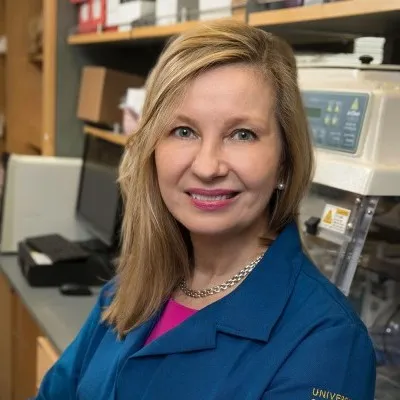
Dr. Andrews is Professor of Psychiatry at the University of California, Los Angeles. Dr. Andrews received her B.S. in Chemistry from the Pennsylvania State University and earned her Ph.D. in Chemistry as a U.S. Department of Education Fellow working at the National Institute of Mental Health, where she was later a postdoctoral fellow and senior staff fellow. At the NIMH, Andrews and her mentor, Dr. Dennis Murphy, discovered and characterized a novel serotonin neurotoxin, 2’-NH2-MPTP. Dr. Andrews was also instrumental in early studies on serotonin transporter-deficient mice. Andrews is a member of the Society for Neuroscience, American Chemical Society, and Society for Electroanalytical Chemistry. She has been the recipient of an NIH Fellows Award for Research Excellence, an Eli Lilly Outstanding Young Analytical Chemist Award, an American Parkinson’s Disease Association Research Award, and a Brain & Behavior Research Foundation (NARSAD) Independent Investigator Award. She is a fellow of the Collegium Internationale Neuropsychopharmacologicum and a Serotonin Club elected councilor. Recently, Dr. Andrews became Associate Editor for ACS Chemical Neuroscience.
At UCLA, Andrews leads efforts in basic and translational research on anxiety and depression, and at the nexus of nanoscience and neuroscience. Andrews’ interdisciplinary research team of neuroscientists, biologists, chemists, and engineers focuses on understanding how the serotonin system and particularly, the serotonin transporter, modulate neurotransmission to influence complex behaviors including anxiety, mood, stress responsiveness, and learning and memory. Genetic and pharmacologic mouse models and human genetic variants are studied to understand the molecular basis of serotonin system function associated with the etiology and treatment of mood and anxiety disorders. Key proteins (e.g., brain-derived neurotrophic factor) and neuronal architectures regulated by serotonin are also investigated. Nanomaterials are designed for fundamental studies on neurotransmitter recognition by native and nonnative binding partners (aptamers) and for the development of in vivo nanobiosensors and functionally directed proteomics.

Source: BRI Website · Updated 8 months ago
10 publications · h-index 54 · PubMed, ORCID and the BRI profile
Showing 10 of 10
Nakatsuka N, Yang KA, Abendroth JM, et al.
Leuchter AF, Cook IA, Hamilton SP, et al.
Liu SS, Pickens S, Burma NE, et al.
Movassaghi CS, Perrotta KA, Yang H, et al.
Ehrlich PF, Pulcini CD, De Souza HG, et al.
Zhao C, Xu X, Ferhan AR, et al.
Dagher M, Cahill CM, Andrews AM.
Climaco P, Mitchell NM, Tyler MJ, et al.
Harrison TM, Ching CR, Andrews AM.
$6.3M total · 3 NIH grants
Micro- to Nanoscale Neurochemical Sensors (NIH RePORTER, opens in a new tab)
R01DA045550Contact PI2017–2023
R01MH064756Contact PI2001–2013
R03MH086108Contact PI2009–2012
Micro- to Nanoscale Neurochemical Sensors (NIH RePORTER, opens in a new tab)
R01DA045550Contact PIFY2017–2021
R01MH064756Contact PIFY2001–2011
R03MH086108Contact PIFY2009–2010
Institute members who share papers or grants with this researcher
AI-generated
Generated automatically from this profile's public data to suggest possibilities. Treat them as starting points rather than recommendations.
Anne Andrews' expertise in chemistry and biochemistry, particularly in neuroscience research, can provide novel molecular tools and insights for Peyman Golshani's detailed investigations into neural circuits and memory. This combination allows for the development of advanced probes to study Golshani's neuronal dynamics and astrocyte signaling.
Project idea: They could collaborate on developing and applying novel chemical probes or imaging agents, informed by Andrews' chemistry background, to visualize and manipulate specific molecular pathways involved in Golshani's studied hippocampal memory encoding sequences or astrocyte signaling in neural circuits.
Anne Andrews' expertise in chemistry and biochemistry, particularly in areas relevant to neuroscience and potentially novel therapeutics, complements Gina Poe's focus on sleep-dependent memory consolidation and neural circuits. Their combined knowledge could lead to the development and testing of new molecular interventions for sleep-related cognitive processes.
Project idea: They could collaborate on a project investigating the biochemical mechanisms underlying sleep-dependent memory consolidation, potentially by designing and testing novel small molecules or aptamers to modulate specific neurotransmitter systems or intracellular signaling pathways identified in Poe's research.
Shared papers, topics or department