Loading profile…

Associate Professor
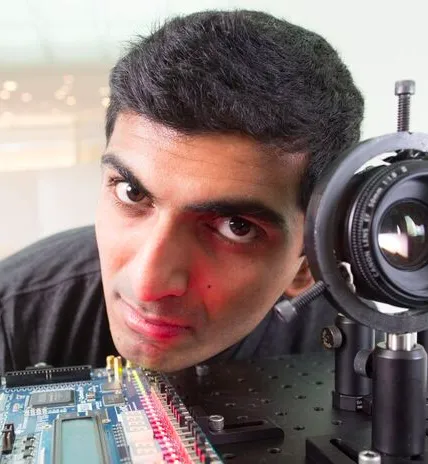
Achuta Kadambi (PhD, MIT ‘18) is an Associate Professor at UCLA in Electrical Engineering and Computer Science. He leads an interdisciplinary research group that focuses on AI, and recruits PhD students from the EE, CS, and Bioengineering Departments. He is the recipient of early career awards including from NSF (CAREER), DARPA (YFA), ARO (YIP), IEEE (HKN under 35 award), and Forbes (30 under 30). He has co-founded two California companies to commercialize research technologies. Kadambi has filed over 70 patents, 30+ of which have been issued to date and has co-authored a textbook, Computational Imaging (MIT Press, 2022).
Source: BRI Website · Updated 8 months ago
Achuta Kadambi's research primarily investigates the intricate processes of self-recognition and self-awareness, particularly how individuals perceive and understand themselves through their own actions and whole-body movements. Their work further examines how motor planning and individual differences influence the perception of social interactions, including the discrimination of threat cues and the interpretation of others' body language, sometimes in the context of neuropsychiatric traits.
Research topics extracted by AI (Google Gemini) from this member’s publications.
3 publications · h-index 30 · PubMed, ORCID and the BRI profile
Kadambi A, Lu H, Monti M, et al.
Jank E, Liu EY, Delery W, et al.
$191K total · 1 NSF grant
CRII: RI: Computational Thermal Imaging (NSF award, opens in a new tab)
1849941PI03/15/2019–02/28/2022
CRII: RI: Computational Thermal Imaging (NSF award, opens in a new tab)
1849941PI03/15/2019–02/28/2022
Institute members who share papers or grants with this researcher
AI-generated
Generated automatically from this profile's public data to suggest possibilities. Treat them as starting points rather than recommendations.
R01 from NIMH
Their research on 'Threat discrimination of real-world social interactions in schizotypal traits' directly aligns with NIMH's mission to understand the etiology and mechanisms of mental illnesses. This work covers social cognition, psychiatric traits, and real-world behavioral assessment, which are core priorities for NIMH.
R01 from NINDS
The publication on 'Motor imagery and self-recognition from actions' is a strong fit for NINDS. This institute supports fundamental neuroscience research, including cognitive and motor control mechanisms, and the use of neuroimaging to understand brain function. The researcher could propose work detailing the neural circuitry or cognitive processes underlying motor imagery and self-perception, potentially linking it to neurological function or dysfunction.
R21 from NIBIB
The co-authored publication on 'Modern Approaches for Thoracic Image Registration and Respiratory Motion Management' suggests expertise in advanced medical imaging techniques and image processing. An NIBIB R21 would be suitable for developing novel neuroimaging methodologies, tools, or computational approaches (e.g., advanced image registration, motion correction, or novel analysis pipelines for fMRI) that could then be applied to their neuroscience questions related to social cognition, motor imagery, or psychiatric conditions.
Shared papers, topics or department