A proposed diagnostic scheme for people with epileptic seizures and with epilepsy: report of the ILAE Task Force on Classification and Terminology. (opens in a new tab)
Engel J Jr, International League Against Epilepsy (ILAE).
Professor
Metrics: Manual · Updated 1 month ago
AI-generated biography
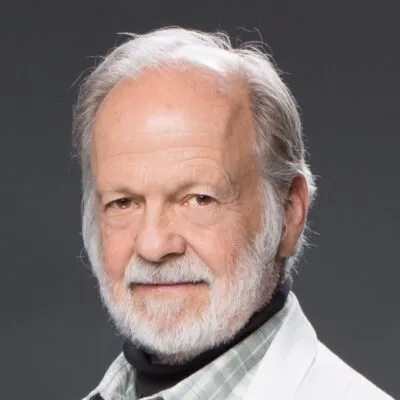
Jerome Engel, M.D., Ph.D., is a distinguished member of the UCLA Brain Research Institute and a Professor in the Department of Neurobiology. His groundbreaking research centers on understanding the fundamental mechanisms of epilepsy, with a particular emphasis on the characterization and clinical utility of pathological high-frequency oscillations (HFOs). Dr. Engel's work employs advanced deep learning and computational analysis of intracranial electroencephalography (iEEG) to map epileptic networks, optimize epilepsy surgery planning through simulated resections, and develop targeted neurostimulation strategies.
His contributions have significantly advanced the field, including seminal publications that have garnered extensive citations, such as the widely referenced definitions of epileptic seizures. Dr. Engel has been a principal investigator on numerous NIH grants focused on in vivo studies of the epileptic hippocampus, underscoring his commitment to fundamental neuroscience research. His clinical trials, such as those investigating early surgical intervention for epilepsy, directly translate his research findings into improved patient care. Dr. Engel's prolific career is marked by a deep dedication to unraveling the complexities of neuronal excitability and epileptic network dynamics to ultimately enhance treatment outcomes for individuals with epilepsy.

Source: Gemini AI · Updated 8 months ago
Jerome Engel's research primarily investigates advanced methods for diagnosing and treating epilepsy, with a particular focus on identifying and characterizing pathological high-frequency oscillations (HFOs) in the brain. His work leverages sophisticated computational and deep learning approaches to analyze intracranial electroencephalography data, aiming to precisely map epileptic networks and optimize therapeutic interventions like neurostimulation and surgical planning to improve seizure outcomes.
Research topics extracted by AI (Google Gemini) from this member’s publications.
Papers by NIH iCite research category (5 of 248 papers classified) · trials from ClinicalTrials.gov · patents from USPTO.
248 publications · PubMed, ORCID and the BRI profile
Showing 10 of 248
Engel J Jr, International League Against Epilepsy (ILAE).
Fisher RS, van Emde Boas W, Blume W, et al.
Engel J Jr, McDermott MP, Wiebe S, et al.
Goldman RI, Stern JM, Engel J Jr, et al.
Engel J Jr, Wiebe S, French J, et al.
Engel J Jr.
Bragin A, Engel J Jr, Wilson CL, et al.
Staba RJ, Wilson CL, Bragin A, et al.
$50.0M total · 11 NIH grants · 1 active
In Vivo Studies of the Epileptic Hippocampus (NIH RePORTER, opens in a new tab)
R01NS033310Contact PI1994–2028
In Vivo Studies of the Epileptic Hippocampus (NIH RePORTER, opens in a new tab)
R01NS033310Contact PIFY1994–2026
In Vivo Studies of the Epileptic Hippocampus (NIH RePORTER, opens in a new tab)
RF1NS033310Contact PIFY1994–2023
P20NS080181Contact PIFY2012–2014
Clinical Research for Partial Epilepsies (NIH RePORTER, opens in a new tab)
P41RR013642Contact PIFY2004–2011
Core--Clinical, Animal and Histology (NIH RePORTER, opens in a new tab)
P01NS002808Contact PIFY1985–2010
In Vivo Studies of the Epileptic Hippocampus (NIH RePORTER, opens in a new tab)
R37NS033310Contact PIFY1994–2010
Early Randomized Surgical Epilepsy Trial (NIH RePORTER, opens in a new tab)
U01NS042372Contact PIFY2002–2007
Multicenter Randomized Clinical Trial (NIH RePORTER, opens in a new tab)
R21NS037897Contact PIFY1999
Internat Conference on Surgical Treatment of Epilepsy (NIH RePORTER, opens in a new tab)
R13NS029615Contact PIFY1992
International Conference on Surgical Therapy of Epilepsy (NIH RePORTER, opens in a new tab)
R13NS021444Contact PIFY1984–1986
Human and Experimental Epilepsy (NIH RePORTER, opens in a new tab)
P01NS015654Contact PIFY1985
1 trial on ClinicalTrials.gov
Early Surgical Intervention to Treat Epilepsy
Conditions: Epilepsy, Epilepsy, Temporal Lobe, Seizures
NCT00040326 on ClinicalTrials.gov (opens in a new tab)200 enrolledSponsor: University of California, Los Angeles2002–2007
Institute members who share papers or grants with this researcher
AI-generated
Generated automatically from this profile's public data to suggest possibilities. Treat them as starting points rather than recommendations.
P01 (Research Program Project Grant)
With multiple R01 grants focused on 'In Vivo Studies of the Epileptic Hippocampus,' this researcher has demonstrated a strong, cohesive research program. A P01 allows for the integration of several highly synergistic and interactive research projects under a single, overarching scientific objective. This would be ideal for tackling a more complex problem in epilepsy research that requires a coordinated, multi-faceted approach, leveraging existing strengths and promoting collaborative innovation beyond the scope of individual R01s.
DP1 (NIH Director's Pioneer Award)
The researcher's success with an RF1 (Exploratory/Developmental Research Grant) indicates a capacity for and interest in high-risk, high-reward, potentially transformative research. The DP1 is specifically designed for established investigators who propose exceptionally innovative and groundbreaking research that could have a significant impact on biomedical science, often challenging existing paradigms. This mechanism would be suitable for a truly bold and unconventional new direction within epilepsy research that might not fit traditional funding pathways.
U01 (Research Project Cooperative Agreement)
If the researcher's 'In Vivo Studies of the Epileptic Hippocampus' are leading to results or methodologies that require broader coordination, standardization, or multi-site validation, a U01 could be highly appropriate. This mechanism supports research projects with significant NIH programmatic involvement, often used for large-scale clinical trials, resource development, or efforts requiring a high degree of collaboration across institutions or with federal agencies, moving towards translational impact or the creation of shared research infrastructure in epilepsy.
Shared papers, topics or department