A method for removal of global effects from fMRI time series. (opens in a new tab)
Macey PM, Macey KE, Kumar R, et al.

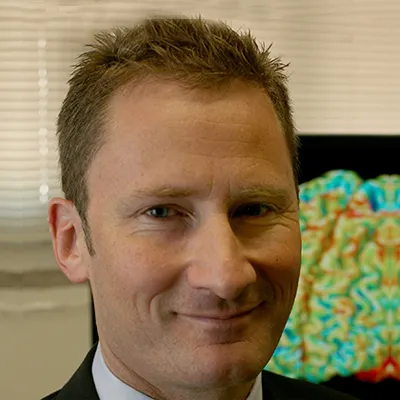
Associate Professor of Nursing
Paul M. Macey is a neuroscientist who has worked at UCLA since 1999. He is an Associate Professor of Nursing, and serves in the School of Nursing Administration as Director of Information Technology and Innovation, and Chief Innovation Officer. Dr. Macey completed a degree in Electrical Engineering at the University of Canterbury, New Zealand, where he focused on bringing engineering approaches to the analysis of breathing signals recorded from infants during sleep. He started at UCLA in a post-doctoral position in the Department of Neurobiology, and continued as and Assistant then Associate Researcher. Dr. Macey then joined the School of Nursing and Brain Research Institute as a faculty member. Dr. Macey teaches in the undergraduate Nursing program, and serves on various faculty committees.
Source: BRI Website · Updated 8 months ago
Paul Macey's research primarily leverages advanced neuroimaging, particularly ultra-high field functional MRI, to investigate the structural and functional organization of the human brain. His work specifically elucidates neural mechanisms underpinning chronic pain conditions like migraine and trigeminal neuropathy, explores autonomic regulation and brain changes associated with obstructive sleep apnea, and examines the neuropathological impact of HIV on brain microstructure and volume. This research aims to deepen our understanding of how the central nervous system contributes to these complex conditions.
Research topics extracted by AI (Google Gemini) from this member’s publications.
Papers by NIH iCite research category (4 of 106 papers classified) · trials from ClinicalTrials.gov · patents from USPTO.
106 publications · h-index 55 · PubMed, ORCID and the BRI profile
Showing 10 of 106
Macey PM, Macey KE, Kumar R, et al.
Macey PM, Kumar R, Woo MA, et al.
Macey PM, Woo MA, Kumar R, et al.
Woo MA, Kumar R, Macey PM, et al.
Kumar R, Chavez AS, Macey PM, et al.
Harper RM, Macey PM, Henderson LA, et al.
Harper RM, Macey PM, Woo MA, et al.
Kumar R, Nguyen HD, Macey PM, et al.
Kumar R, Woo MA, Macey PM, et al.
Henderson LA, Woo MA, Macey PM, et al.
$7.0M total · 5 NIH grants · 1 active
Neural effects of breathing training in obstructive sleep apnea (NIH RePORTER, opens in a new tab)
R01HL181480Contact PI2025–2029
Neural effects of breathing training in obstructive sleep apnea (NIH RePORTER, opens in a new tab)
R01HL181480Contact PIFY2025–2026
R01HL135562Contact PIFY2018–2021
Sex-specific brain injury and symptoms in sleep apnea (NIH RePORTER, opens in a new tab)
R56NR017435Contact PIFY2018
Obstructive Sleep Apnea, Gender Biology, and Autonomic Regulation (NIH RePORTER, opens in a new tab)
R01NR013693Contact PIFY2013–2017
R21NR011230Contact PIFY2009–2010
1 trial on ClinicalTrials.gov
BreatheWell: Train Your Breathing, Relax Your Body, Open Your Mind
Conditions: Healthy
NCT06920407 on ClinicalTrials.gov (opens in a new tab)150 enrolledSponsor: University of California, Los Angeles2024–2026
Institute members who share papers or grants with this researcher

AI-generated
Generated automatically from this profile's public data to suggest possibilities. Treat them as starting points rather than recommendations.
P01 (Program Project Grant)
Given the researcher's multiple R01s focused on interconnected aspects of obstructive sleep apnea (neural mechanisms, GABA/glutamate, autonomic function, breathing training), a P01 would allow them to integrate these distinct but related projects into a single, cohesive research program. This mechanism fosters collaboration among multiple PIs, tackles broader scientific questions that cannot be addressed by individual R01s, and is a logical next step for an established investigator seeking to expand and consolidate their research efforts.
R35 (Outstanding Investigator Award or MIRA)
With a strong track record of securing multiple R01 grants in a focused area, this researcher is likely a highly productive and established investigator. An R35 award (e.g., from NIGMS or other participating ICs) would provide substantial, long-term, and flexible funding for their overall research program, rather than a single project. This supports the investigator's continued innovation and allows for greater scientific freedom, potentially freeing them from the constant cycle of multiple individual R01 applications.
U01 (Research Project Cooperative Agreement)
The researcher's work on 'neural effects of breathing training in obstructive sleep apnea' suggests a strong translational path towards clinical interventions. A U01 cooperative agreement is well-suited for larger, often multi-site clinical trials or coordinated research initiatives, especially if the breathing training intervention is ready for broader testing or if there's a specific NIH initiative they could align with regarding sleep disorders, autonomic dysfunction, or behavioral interventions. This mechanism involves substantial NIH staff involvement, facilitating complex, collaborative projects.
Shared papers, topics or department