Activation of specific interneurons improves V1 feature selectivity and visual perception. (opens in a new tab)
Lee SH, Kwan AC, Zhang S, et al.
2012456 citationsRCR 11.3698th percentile

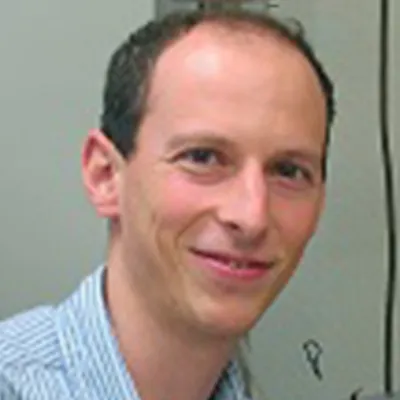
Professor
AI-generated biography
Sotiris Masmanidis, Ph.D., is an Assistant Professor in the Department of Neurobiology at UCLA. He earned his Ph.D. from the University of California, Berkeley. Dr. Masmanidis's research program is dedicated to understanding the computational principles and neural circuit dynamics that govern learning, memory, decision-making, and the precise encoding of time. His laboratory employs cutting-edge nanofabrication techniques for high-density neural recording and advanced computational analysis to map the activity of neuronal populations in vivo.
His work has made significant contributions to our understanding of striatal dopamine signaling, thalamocortical circuit activity, and the role of interneurons in associative learning. Dr. Masmanidis's research has been published in high-impact journals, with notable publications including "Activation of specific interneurons improves V1 feature selectivity and visual perception" and "Nanotools for neuroscience and brain activity mapping." He has also been awarded multiple grants from the National Institutes of Health to support his investigations into the neurophysiology of Parkinson's disease, the encoding of time in corticostriatal circuits, and the dopaminergic mechanisms of reinforcement learning.
Source: Gemini AI · Updated 8 months ago
Sotiris Masmanidis's research focuses on deciphering the dynamic neural circuit mechanisms that underlie learning, reward-conditioned behaviors, and the precise encoding of time. Their work specifically investigates how striatal and prefrontal networks, modulated by factors like dopamine and interneurons, process information and how these circuits are disrupted in various neurodevelopmental and neurodegenerative disorders.
Research topics extracted by AI (Google Gemini) from this member’s publications.
35 publications · h-index 26 · PubMed, ORCID and the BRI profile
Showing 10 of 35
Lee SH, Kwan AC, Zhang S, et al.
Nagai J, Rajbhandari AK, Gangwani MR, et al.
Alivisatos AP, Andrews AM, Boyden ES, et al.
Shuman T, Aharoni D, Cai DJ, et al.
Bakhurin KI, Goudar V, Shobe JL, et al.
Shobe JL, Claar LD, Parhami S, et al.
Lee K, Holley SM, Shobe JL, et al.
Du J, Blanche TJ, Harrison RR, et al.
Lazaro MT, Taxidis J, Shuman T, et al.
Zhou S, Masmanidis SC, Buonomano DV.
$8.7M total · 6 NIH grants · 2 active
R01NS136137Contact PI2024–2029
R01DA060229Contact PI2025–2030
R01NS136137Contact PIFY2024–2026
R01DA060229Contact PIFY2025–2026
R01NS125877Contact PIFY2021–2025
R01DA042739Contact PIFY2017–2021
R01NS100050Co-PIFY2016–2020
Systems-level electrophysiology for addiction and reward research (NIH RePORTER, opens in a new tab)
R01DA034178Contact PIFY2012–2016
Institute members who share papers or grants with this researcher





AI-generated
Generated automatically from this profile's public data to suggest possibilities. Treat them as starting points rather than recommendations.
R35 (Maximizing Investigators' Research Award - MIRA, specifically NINDS PD-MIRA)
The researcher has multiple active R01s, demonstrating a strong track record of independent research, including significant work on Parkinson's disease. The NINDS R35 (Parkinson's Disease Research: Maximizing Investigator's Research Award - PD-MIRA) specifically targets established investigators with outstanding research programs focused on Parkinson's disease. This mechanism provides more stable, flexible, and longer-term support (up to 5 years), allowing the researcher to pursue broad research goals related to Parkinson's and motor control without the burden of constant R01 renewals, consolidating their efforts and fostering scientific creativity across their established program.
U01 (Research Project Cooperative Agreement) through relevant initiatives (e.g., BRAIN Initiative, Parkinson's disease consortia)
Given the researcher's success with CRCNS R01s, they are adept at collaborative and interdisciplinary research often involving computational and experimental approaches. A U01 (Research Project Cooperative Agreement) would be suitable for participating in or leading larger, often multi-site, NIH initiatives (e.g., the BRAIN Initiative for developing new tools or mapping circuits, or specific NINDS consortia for Parkinson's disease or motor control disorders). This mechanism is appropriate for complex projects requiring significant coordination and where NIH staff have substantial scientific involvement, leveraging the researcher's expertise in neurophysiology, circuits, and timing within a broader, strategically directed program.
P01 (Research Program Project Grant)
With multiple R01s spanning distinct yet related areas—Parkinson's disease, motor control, corticostriatal circuits, timing, and reinforcement learning—the researcher is well-positioned to propose a P01 (Research Program Project Grant). A P01 supports a group of highly related, synergistic research projects that share a common theme and overall objective. This would allow the researcher to integrate their diverse but complementary expertise into a comprehensive, larger-scale program (e.g., investigating multiple facets of corticostriatal dysfunction underlying motor and cognitive impairments in Parkinson's disease), fostering deeper collaboration among distinct but complementary projects under one overarching grant.
 Kate WassumPsychologyFit 8/10
Both researchers focus on the role of dopamine and striatal circuits in reward-related behaviors, with Masmanidis bringing expertise in neural dynamics and circuit activity, and Wassum focusing on decision-making, goal-directed behavior, and addiction. Their complementary expertise could provide a comprehensive understanding of how neural circuit activity drives and is modulated by reward pursuit and its dysregulation.
Project idea: They could jointly investigate how specific patterns of striatal dopamine signaling dynamics, as measured by Masmanidis, underpin goal-directed decision-making and habit formation in addiction models, as studied by Wassum.
 Andrew WikenheiserPsychologyFit 8/10
Their research on striatal dopamine signaling and reward-based decision-making shows strong complementary potential, allowing for investigation into the neural underpinnings of choice behavior.
Project idea: They could collaborate on a project investigating how striatal dopamine dynamics influence effort-delay trade-offs and subjective preference in decision-making tasks.
 Alicia IzquierdoPsychologyFit 8/10
Their research areas strongly complement each other, bridging learning and decision-making from the psychological and computational perspective (Izquier) with the detailed neural circuit and dynamic signaling mechanisms (Masmanidis). This combination is ideal for investigating the neural underpinnings of complex cognitive processes.
Project idea: They could collaborate on a project investigating how striatal dopamine signaling dynamics and neural ensemble activity (Masmanidis) contribute to flexible learning and decision-making under uncertainty and risk, as studied by Izquier.
Aydin's expertise in wireless neuromodulation systems directly complements Sotiris's research into neural circuits and their function. This pairing could enable advanced in-vivo studies of neural activity during stimulation.
Project idea: They could jointly develop and deploy a wireless vagus nerve stimulation system to investigate its impact on social behavior, dopamine signaling, and reward pathways in animal models.
 Jaime CastrellonPsychologyFit 8/10
Their research areas deeply complement each other, with Castrellon's broad neuroscience research likely benefiting from Masmanidis's specific expertise in neural circuits and dopamine signaling. Combining their skills could lead to novel insights into the neural underpinnings of behavior.
Project idea: They could collaborate on a project investigating how specific neural circuit dynamics, as mapped by Masmanidis, influence behavioral outcomes studied within the scope of Castrellon's psychology-focused neuroscience research.
 Avishek AdhikariPsychologyFit 7/10
Their research areas complement each other significantly, with one focusing on defensive behaviors and the other on reward and social circuits, both leveraging advanced neural circuit mapping. Combining their expertise could illuminate how threat and reward systems interact to shape behavior.
Project idea: They could investigate how fear extinction (Adhikari) influences reward-seeking behaviors and striatal dopamine signaling (Masmanidis) in the context of addiction or social interactions.
 Ausaf BariNeurosurgeryFit 7/10
Dr. Bari's broad neuroscience expertise, particularly in neurosurgery which implies a strong understanding of brain anatomy and surgical techniques, complements Dr. Masmanidis's detailed focus on specific neural circuits and neurobiological mechanisms. Their combined knowledge could bridge the gap between fundamental circuit function and its potential application or understanding in clinical contexts.
Project idea: Investigate the neurobiological underpinnings of social behavior deficits in neurosurgical patients by applying Dr. Masmanidis's circuit-level analysis techniques to patient populations managed by Dr. Bari.
 Laura DeNardoPhysiologyFit 7/10
Laura DeNar's broad neuroscience research in physiology can provide foundational understanding and methodological expertise that complements Sotiris Masmanidis's highly specific investigations into neural circuits of social behavior and related functions. Their combined expertise could lead to a deeper mechanistic understanding of these complex behaviors.
Project idea: They could collaborate on a project investigating the physiological underpinnings of the neural circuit dynamics Masmanidis studies in social behavior, potentially using advanced physiological recording techniques developed or refined by DeNar.
 Ahmet AracNeurologyFit 7/10
Ahmet's focus on motor control and machine learning in stroke rehabilitation could benefit from Sotiris's expertise in neural circuits, dopamine signaling, and temporal encoding, particularly in understanding the underlying neural mechanisms of motor recovery. Combining their skills could lead to novel insights into how neural activity drives and is modulated during motor learning and rehabilitation.
Project idea: They could collaborate on a project to use machine learning to analyze neural population dynamics (from Sotiris's work) during motor tasks in stroke patients (Ahmet's population) to identify neural signatures predictive of rehabilitation success.
Their research areas complement each other by linking detailed neural circuit dynamics (Masmanidis) with systems-level understanding of sleep and memory consolidation (Poe), offering a pathway to investigate how specific circuit activities during sleep impact memory.
Project idea: They could investigate the role of striatal dopamine signaling dynamics and interneuron activity during different sleep stages in the consolidation of learned associations.
Shared papers, topics or department