Expanded GGGGCC hexanucleotide repeat in noncoding region of C9ORF72 causes chromosome 9p-linked FTD and ALS. (opens in a new tab)
DeJesus-Hernandez M, Mackenzie IR, Boeve BF, et al.
20113,889 citationsRCR 95.2599th percentile

Professor
AI-generated biography
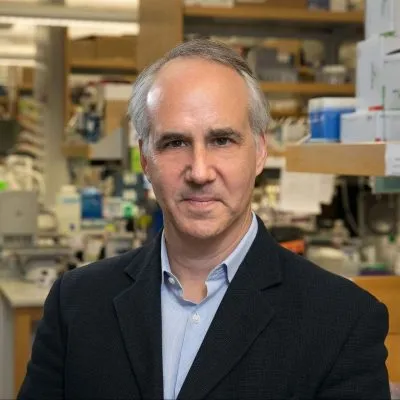
Daniel Geschwind, M.D., Ph.D., is a distinguished Professor in the Department of Neurology at UCLA. His research is dedicated to unraveling the genetic and molecular basis of complex neurological and neurodevelopmental disorders, with a particular focus on autism spectrum disorder and neurodegenerative diseases. Dr. Geschwind employs cutting-edge multi-omics approaches, including spatial transcriptomics and neurogenomics, to map brain development, identify cell-type specific gene expression patterns, and understand the molecular pathology of these conditions. His seminal work has significantly advanced our understanding of the genetic architecture of psychiatric disorders and autism, leading to the identification of numerous risk loci and de novo mutations. Dr. Geschwind has authored highly cited publications and secured substantial funding from the National Institutes of Health to support his pioneering research, including initiatives focused on high-throughput phenotyping and increasing diversity in autism genetics research. His contributions have been instrumental in developing comprehensive human brain atlases and elucidating the molecular signatures of brain development and disease.
Source: Gemini AI · Updated 8 months ago
Daniel Geschwind's research extensively explores the molecular and cellular underpinnings of complex neurological and neurodevelopmental disorders, such as autism and various dementias. Their work employs advanced multi-omics approaches, including genomics, transcriptomics, and proteomics, to identify genetic susceptibilities, disease-specific pathways, and molecular signatures, with the ultimate goal of developing improved diagnostics and therapeutic interventions.
Research topics extracted by AI (Google Gemini) from this member’s publications.
Papers by NIH iCite research category (3 of 617 papers classified) · trials from ClinicalTrials.gov · patents from USPTO.
617 publications · h-index 195 · PubMed, ORCID and the BRI profile
Showing 10 of 617
DeJesus-Hernandez M, Mackenzie IR, Boeve BF, et al.
Hawrylycz MJ, Lein ES, Guillozet-Bongaarts AL, et al.
Sebat J, Lakshmi B, Malhotra D, et al.
Grove J, Ripke S, Als TD, et al.
Sanders SJ, Murtha MT, Gupta AR, et al.
Naj AC, Jun G, Beecham GW, et al.
Pinto D, Pagnamenta AT, Klei L, et al.
Demontis D, Walters RK, Martin J, et al.
$125.5M total · 27 NIH grants · 5 active
R56MH143740Co-PI2026–2027
RM1MH132651Contact PI2023–2028
RF1MH100027Contact PI2013–2028
OT2OD040572Contact PI2025–2028
R01MH100027Contact PI2013–2028
R56MH143740Co-PIFY2026
RM1MH132651Contact PIFY2023–2026
RF1MH100027Contact PIFY2013–2025
OT2OD040572Contact PIFY2025
R01MH100027Contact PIFY2013–2024
U01MH116489Contact PIFY2018–2022
UH3NS104095Contact PIFY2017–2021
U01MH115746Contact PIFY2017–2021
Genetics and Biomarkers Core (NIH RePORTER, opens in a new tab)
P50HD055784Contact PIFY2007–2021
R01MH109912Contact PIFY2016–2020
Training Grant in Neurobehavioral Genetics (NIH RePORTER, opens in a new tab)
T32MH073526Co-PIFY2005–2020
UG3NS104095Contact PIFY2017–2019
R01MH110927Contact PIFY2016–2019
U01MH105578Co-PIFY2014–2018
U01MH105991Contact PIFY2014–2016
R01MH094714Contact PIFY2011–2015
R37MH060233Contact PIFY1999–2014
Neurogenomics/Bioinformatics Core (NIH RePORTER, opens in a new tab)
P30HD004612Contact PIFY2010–2014
R01MH081754Contact PIFY2008–2012
P30MH089901Contact PIFY2009–2010
R01AG026938Contact PIFY2005–2009
A Genomewide Search for Autism Susceptibilty Loci (NIH RePORTER, opens in a new tab)
R01MH064547Contact PIFY2002–2006
Identification of targets of FoxP2 in the brain (NIH RePORTER, opens in a new tab)
R21MH075028Contact PIFY2005–2006
Asymmetrically-Expressed Genes in Developing Human Cerebrum (NIH RePORTER, opens in a new tab)
R56MH060233Contact PIFY1999–2005
The Genetics of Idiopathic Basal Ganglia Calcification (NIH RePORTER, opens in a new tab)
R01NS040752Contact PIFY2001–2004
Asymmetrically Expressed Genes in Developing Cerebrum (NIH RePORTER, opens in a new tab)
R01MH060233Contact PIFY1999–2003
Localization of a Gene Underlying Cerebral Laterality (NIH RePORTER, opens in a new tab)
K08NS001849Contact PIFY1995–1999
Institute members who share papers or grants with this researcher





AI-generated
Generated automatically from this profile's public data to suggest possibilities. Treat them as starting points rather than recommendations.
U01 (Research Project Cooperative Agreement)
Given the researcher's current involvement in a High-Throughput Neuropsychiatric Disorder Phenotyping Center (RM1) and projects focused on 'Increasing Representation of Human Diversity' and 'Data science approaches to autism,' a U01 would be an excellent fit. U01s support large-scale, often multi-site, research projects where substantial interaction and coordination between the NIH and the awardee are anticipated. This mechanism is ideal for developing shared resources, conducting large observational studies, or validating high-throughput phenotyping methods across diverse populations, aligning well with their established expertise in large-scale data generation and diversity initiatives in neuropsychiatric disorders.
P50 (Specialized Center)
The researcher already leads an RM1 for a 'High-Throughput Neuropsychiatric Disorder Phenotyping Center.' A P50 grant would represent a significant programmatic expansion, establishing a comprehensive 'Specialized Center of Research Excellence' focusing on autism or a broader spectrum of neuropsychiatric disorders. P50s support multiple synergistic research projects (often equivalent to several R01s) under one administrative and scientific umbrella, along with shared core facilities. This would allow them to integrate their genetics, phenotyping, data science, and diversity efforts into a more cohesive, sustained, and impactful multi-investigator program than what an RM1 typically provides, fostering deeper collaboration and sustained research impact.
R24 (Resource-Related Research Project - Program)
With strong foundations in 'High-Throughput Neuropsychiatric Disorder Phenotyping' and 'Data science approaches to autism' that involve environmental modulators of the transcriptome and gene-x-environment interactions, the researcher is likely generating significant research resources. An R24 mechanism directly supports the creation, maintenance, and dissemination of such resources for the broader scientific community. This could include developing a comprehensive, diverse database of autism-related phenotype/genotype/transcriptome data, advanced high-throughput screening platforms, or sophisticated bioinformatics tools and pipelines for gene-environment interaction analysis, thereby leveraging their existing capabilities to benefit the wider research community.
Their research areas are highly complementary, with Geschwind focusing on the genetic and molecular underpinnings of neurodevelopmental and neurodegenerative disorders, and Zipursky investigating the cellular and molecular mechanisms of neuronal wiring and circuit assembly. Combining these areas could provide a comprehensive understanding of how genetic predispositions impact the precise formation and function of neural circuits, and vice-versa.
Project idea: They could collaborate on a project to investigate how specific genetic mutations associated with autism spectrum disorder (ASD) affect the development of synaptic specificity and neuronal wiring in relevant brain circuits, using Geschwind's genomic expertise and Zipursky's focus on neuronal assembly mechanisms.
Researcher A's expertise in wireless neurostimulation systems for the vagus nerve could provide a novel technological platform to modulate neural activity, directly complementing Researcher B's extensive work on the genetic and molecular underpinnings of neurodevelopmental and psychiatric disorders.
Project idea: They could collaborate on a project using Aydin Babakhani's wireless vagus nerve stimulation system to investigate the impact of precise vagal nerve modulation on gene expression patterns and neural circuit function in animal models of autism spectrum disorder or other neurodevelopmental conditions studied by Daniel Geschwind.
Geschwind's expertise in neurodevelopmental disorders, brain mapping, and cell-type specific gene expression, combined with Poe's focus on sleep-dependent memory consolidation and neural circuits of arousal, offers a strong opportunity to investigate how neurodevelopmental genetic factors impact sleep and memory.
Project idea: They could jointly investigate the role of specific genes implicated in autism spectrum disorder on sleep architecture and subsequent memory consolidation in relevant animal models or human cohorts.
While their fields are distinct (ocular development vs. brain development), both researchers focus on gene expression regulation during development, presenting a potential for complementary approaches. Their expertise could be combined to investigate molecular signatures of developmental processes across different tissues or to explore conserved gene regulatory mechanisms.
Project idea: They could collaborate on a comparative transcriptomic study of early ocular and brain development to identify conserved genetic pathways and regulatory elements that are critical for neurodevelopmental and ocular development, potentially shedding light on shared molecular mechanisms underlying neurodevelopmental disorders that have ocular manifestations.
 Mario DipoppaNeurobiologyFit 7/10
Their research areas complement each other by bridging the gap between fundamental neural processing (visual cortex adaptation) and the genetic and developmental underpinnings of complex brain disorders, potentially linking molecular mechanisms to observable neural function.
Project idea: Investigate how genetic predispositions for autism spectrum disorder, studied through spatial transcriptomics, might influence the neural adaptation mechanisms within the visual cortex.
 Avishek AdhikariPsychologyFit 7/10
Researcher A's expertise in the neural circuits of defensive behaviors (fear, flight) strongly complements Researcher B's work on the genetic and molecular underpinnings of neurodevelopmental and psychiatric disorders, particularly those involving social behavior and anxiety. Combining these could elucidate the developmental trajectories of fear and anxiety circuits.
Project idea: Investigate the genetic and molecular factors influencing the development and function of amygdala and periaqueductal gray circuits involved in fear and defensive behaviors in the context of autism spectrum disorder or other neurodevelopmental disorders.
Amjad's expertise in single-cell signaling dynamics and genetic recording offers a powerful toolkit to interrogate the complex cellular and molecular mechanisms driving brain development and disorders that Daniel studies. Daniel's extensive work on the genetics of neurodevelopmental disorders and spatial transcriptomics provides rich biological context and data for Amjad to apply his experimental approaches.
Project idea: They could collaborate to develop and apply genetic reporters to map dynamic signaling events in specific cell types within developing or diseased brain tissue, integrating this with Daniel's spatial transcriptomic data to understand how signaling patterns influence cell fate and circuit formation in neurodevelopmental disorders.
 Ausaf BariNeurosurgeryFit 6/10
While Researcher A's broad focus on 'neuroscience research' doesn't offer specific alignment, their MD/PhD and neurosurgery background could provide clinical insights and access to neurological patient data, complementing Researcher B's deep expertise in the molecular and genetic underpinnings of neurodevelopmental and neurodegenerative disorders.
Project idea: They could collaborate on a project investigating the molecular signatures of neurological conditions in surgical samples, integrating gene expression data with clinical outcomes.
Shared papers, topics or department