Full-length human mutant huntingtin with a stable polyglutamine repeat can elicit progressive and selective neuropathogenesis in BACHD mice. (opens in a new tab)
Gray M, Shirasaki DI, Cepeda C, et al.
2008493 citationsRCR 10.4998th percentile

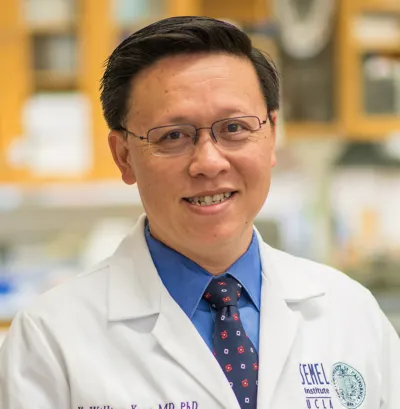
Professor in Residence
David Geffen School of Medicine
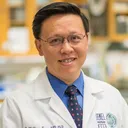
Dr. X. William Yang is a professor in the Department of Psychiatry & Biobehavioral Sciences at David Geffen School of Medicine at UCLA. He is also a member of the Center for Neurobehavioral Genetics at Semel Institute for Neuroscience & Human Behaviors, and a member of the Brain Research Institute at UCLA. He has served as a regular member at the NIH’s Cell Death in Neurodegeneration (CDIN) Study Section, a Scientific Advisory Board member of the Hereditary Disease Foundation, and a faculty member for Faculty 1000 Medicine?s Neurogenetics Section. William grew up in Tianjin, China. He obtained a combined M.S. and B.S. degrees with summa cum laude from Molecular Biophysics & Biochemistry Department at Yale University in 1991. He received Ph.D. in Molecular Genetics and Neuroscience from Rockefeller University in 1998. During his PhD thesis research with Dr. Nathaniel Heintz, William co-invented (together with Nat Heintz and Peter Model) the first recombineering technology to modify large pieces of DNA called Bacterial Artificial Chromosomes (BACs) and to generate BAC transgenic mice. The BAC transgenic technology is now a widely-used tool to generate transgenic animals for analyses of gene expression and gene function, and for modeling human diseases. After obtaining his Ph.D. degree, William went on to complete his M.D. training from Weill Medical College of Cornell University in 2000, and his Medicine Internship at New York-Presbyterian Hospital in 2001. After a brief postdoctoral training with Nat Heintz at Rockefeller University, William joined UCLA as an Assistant Professor in Dept. of Psychiatry in 2002.
Source: BRI Website (AI extract) · Updated 8 months ago
89 publications · h-index 54 · PubMed, ORCID and the BRI profile
Showing 10 of 89
Gray M, Shirasaki DI, Cepeda C, et al.
Yang XW, Model P, Heintz N.
Lee CYD, Daggett A, Gu X, et al.
Langfelder P, Cantle JP, Chatzopoulou D, et al.
Hintiryan H, Foster NN, Bowman I, et al.
Yau RG, Doerner K, Castellanos ER, et al.
Lobo MK, Karsten SL, Gray M, et al.
Foster NN, Barry J, Korobkova L, et al.
Peñagarikano O, Lázaro MT, Lu XH, et al.
Jiang M, Wang J, Fu J, et al.
$40.5M total · 14 NIH grants · 3 active
R61AG090398Co-PI2024–2026
R61NS140733Contact PI2025–2026
U01AG076804Co-PI2022–2027
R61AG090398Co-PIFY2024–2026
R61NS140733Contact PIFY2025–2026
U01AG076804Co-PIFY2022–2025
R01NS113612Contact PIFY2019–2023
U01MH117079Contact PIFY2018–2022
RF1MH128888Contact PIFY2021
P50DA005010Contact PIFY1987–2021
R01NS084298Contact PIFY2014–2018
RF1AG056114Contact PIFY2017
U01MH106008Contact PIFY2014–2016
R01NS074312Contact PIFY2011–2014
Conditional Models: non-cell-autonomous Toxicities in HD (NIH RePORTER, opens in a new tab)
R01NS049501Contact PIFY2004–2014
R01HD065298Contact PIFY2009–2010
Genetic Suppressors of Huntington's Disease in Mice (NIH RePORTER, opens in a new tab)
R21NS047391Contact PIFY2004–2005
Institute members who share papers or grants with this researcher








AI-generated
Generated automatically from this profile's public data to suggest possibilities. Treat them as starting points rather than recommendations.
 Carlos Portera-CailliauNeurologyFit 8/10
Their research areas are highly complementary, with Portera-Cailliau focusing on circuit mechanisms of neurodevelopmental disorders and Yang on their genetic and cellular underpinnings, offering a strong foundation for collaborative investigation.
Project idea: They could jointly investigate how specific genetic mutations or polygenic risk scores identified by Yang influence neuronal circuit development, plasticity, and excitation-inhibition balance in models of autism spectrum disorder, as studied by Portera-Cailliau.
Researcher A's expertise in pre-mRNA splicing regulation, particularly in the context of RNA-binding proteins like Rbfox1, directly complements Researcher B's focus on autism spectrum disorder genetics and gene regulation. Many genetic factors implicated in ASD are believed to affect splicing.
Project idea: Investigate how dysregulation of splicing factors, such as Rbfox1, contribute to the genetic basis of autism spectrum disorder using pluripotent stem cell models and advanced imaging techniques.
Gina Poe's expertise in sleep-dependent memory consolidation and neural circuits of arousal regulation could complement Xiangdong Yang's work on TBI mechanisms and neural repair by glial cells, particularly in understanding how sleep disturbances post-TBI impact cognitive function and repair processes.
Project idea: They could investigate the role of sleep quality and memory consolidation deficits in the long-term cognitive outcomes of traumatic brain injury, using Yang's models and Poe's sleep analysis techniques.
 Samantha ButlerNeurobiologyFit 7/10
Samantha's expertise in neural progenitor cell differentiation and neuronal development strongly complements Xiangdong's research on autism spectrum disorder genetics, TBI mechanisms, and neuronal repair by glial cells. This pairing offers significant potential for investigating the developmental origins of neurological disorders and the mechanisms of neural repair.
Project idea: They could collaborate on a project using pluripotent stem cells to model neurodevelopmental deficits associated with autism or TBI, investigating how genetic factors identified by Xiangdong influence progenitor cell differentiation pathways studied by Samantha, and then explore glial cell-mediated repair strategies.
 Laura DeNardoPhysiologyFit 7/10
Laura's broad neuroscience research could benefit from Xiangdong's specific expertise in autism genetics, TBI mechanisms, and stem cell-based neural repair, particularly his advanced imaging and AI segmentation techniques.
Project idea: They could investigate the cellular and genetic underpinnings of neuronal glial network dysfunction in autism spectrum disorder or traumatic brain injury using stem cell models and advanced imaging analysis developed by Dr. Yang.
 Ranmal SamarasingheNeurologyFit 7/10
Researcher A's expertise in epilepsy modeling using human brain organoids and stem cell-derived neurons strongly complements Researcher B's focus on autism spectrum disorder genetics, traumatic brain injury mechanisms, and pluripotent stem cell differentiation. Both researchers work with stem cell-derived models and neural systems.
Project idea: They could collaborate to investigate the genetic underpinnings of network dysfunction in induced pluripotent stem cell (iPSC)-derived neuronal models of epilepsy, potentially identifying common pathways or therapeutic targets relevant to both epilepsy and neurodevelopmental disorders like ASD.
Both researchers share an interest in autism spectrum disorder (ASD) and genetics, with Stephanie White focusing on social motivation in ASD and Xiangdong William Yang on ASD genetics, creating a natural bridge for collaborative research. Their expertise in neural circuits and gene regulation can be combined to explore the genetic underpinnings of social deficits in ASD.
Project idea: They could collaborate on a project investigating the genetic and neural mechanisms underlying social motivation deficits in individuals with ASD, potentially utilizing animal models of ASD and advanced imaging techniques.
 Ahmet AracNeurologyFit 7/10
Ahmet's expertise in motor control and machine learning for neurorehabilitation could be applied to analyze complex neural and behavioral data generated by Xiangdong's work on TBI mechanisms and glial cell repair in the context of neurological disorders.
Project idea: They could collaborate on a project investigating how glial cell-mediated neural repair influences motor recovery in stroke patients using machine learning to analyze high-resolution imaging and kinematic data.
Amjad's expertise in cellular signaling dynamics and genetic recording could provide a mechanistic lens for understanding the genetic and cellular underpinnings of Xiangdong's work on autism and TBI, particularly in neuronal-glial interactions. Xiangdong's focus on specific disease contexts (autism, TBI) and advanced imaging could benefit from Amjad's ability to decipher complex cellular signaling events within these systems.
Project idea: They could collaborate to develop and apply Amjad's genetic recording tools to investigate the dynamic cellular signaling pathways dysregulated in pluripotent stem cell-derived neuronal-glial networks from individuals with autism spectrum disorder or from models of traumatic brain injury.
 Avishek AdhikariPsychologyFit 6/10
Their research areas are complementary, with Avishek focusing on fear and defensive behaviors and Xiangdong on neurobiology relevant to neurological disorders, offering a potential bridge between basic behavioral neuroscience and clinical applications.
Project idea: They could collaborate on a project investigating the neurobiological underpinnings of fear extinction deficits in models of traumatic brain injury or autism spectrum disorder, utilizing Avishek's behavioral paradigms and Xiangdong's expertise in stem cell-derived neuronal networks and genetic analysis.
While their core research areas (insect visual systems vs. human neurodevelopmental/injury disorders) are quite disparate, there's a potential for indirect synergy through shared methodologies and broader themes. Both researchers utilize advanced imaging and genetic/molecular approaches.
Project idea: They could potentially collaborate on developing or refining high-resolution imaging techniques or quantitative AI segmentation for analyzing complex neural circuits, applicable to both insect models and human tissue samples, or perhaps exploring how neuromodulatory systems, studied in flies, might inform understanding of TBI or ASD. However, a direct, impactful collaboration is less obvious given the fundamental differences in their biological systems.
While their core research areas are distinct (ocular lens development vs. neuroscience/genetics), both researchers investigate gene regulation and utilize advanced biological techniques, offering a very indirect and limited potential for overlap.
Project idea: They could explore if genes involved in ocular lens development have any parallels or regulatory mechanisms that are disrupted in certain neurodevelopmental disorders like autism, using stem cell models.
Shared papers, topics or department